Showing posts with label iPod. Show all posts

Sunday, December 02, 2007

E-book readers: they look good on paper

There's been some talk about Amazon's new Kindle e-book reader being the "iPod of books." This analogy might be cute and catchy, but it's deeply flawed, and wishful thinking at best.

First, being the iPod of books is a very ambitious undertaking. Much more so than being the iPod of music. Here's why:

  1. With the iPod, the content that the device was built for is music. The display is only an organizer for it. The actual presentation of the content is audio playback. With an e-book reader, however, the display has to serve not only as an organizer, but also as the actual presentation canvas for the content itself. And that's hard, because
  2. electric devices have been able to play back music for decades. Most users were already satisfied with the sound quality of existing MP3 players even before the iPod debuted, so Apple's device didn't need to achieve a technological breakthrough in its core competence of music playback. However, no electric device exists today that could "play back" a book or a newspaper at an acceptable quality. Therefore, a successful e-book reader will need to break new ground.
  3. Listening is passive, while reading is active. Listening to a song only requires you to push the play button, and the rest will just happen to you. However, reading a book requires constant and conscious interaction: not just scanning the text with your eyeballs, but also physically navigating the book by turning pages.* A device for reading has to facilitate that as well in a very humane and user-friendly way, not to mention providing additional functionality such as annotation features**.
*What if an e-book reader could automatically scroll, tracking your eyeballs?

**This blog post of mine is serving me as a great lesson about procrastination. I've been working on it for over a week, and in the meantime, several other web authors have posted their opinions, which are in some cases very similar to mine. Ars Technica's John Stokes, for example, mentions annotation features, as well as several other points I also visit.


The Muzak of Books

But there's more on the iPod analogy front. The music you hear on an iPod is comparable to what you hear on your stereo. Sure, the quality is certainly not the same as on a high-end device, but it's is acceptable for the vast majority of users, most of whom would be hard-pressed to tell much of the difference anyway.

However, just imagine, for a moment, an iPod that could only play a MIDI version of any song. You would hear your favorite songs arranged for generic software instruments, and some machine voice would do all the vocals.

Would this device be a hit? Would you buy it?

I'm asking because this is more or less what Kindle, or any other e-book solution on the market today, does. What it presents is nothing but the MIDI version of a book. Layout is generated on the fly, using a generic font. Sure, the original words are kept, just like the original notes in a MIDI version of a song. But yet it's not the same song, and it's not the same book. It's the Muzak version of a book. It looks more like a webpage. Compared to the real thing, it's an abomination.

Readers want the real thing; the book as it has been designed and laid out by design professionals.

Sure, Muzak has its place in elevators and public toilets, but it's not the music you love, it's not what inspires your kids to write fan mail. And the same way, Kindle is perfectly suitable for reading an end-user license agreement or a shopping list – but not something you care about, not something you grow attached to.


A book reader? That's me!

And finally, there's a third thing. Your iPod does not equal to the music on it. The two are very separate things. An iPod is just the device that plays your music. The music is something you cannot touch, wherever it's coming from. A band, a stereo, a clock radio, an iPod: these are sources of music, you never think of them as the music itself. You don't even think of a CD as the music itself: it's just a recording that you have to get music out of by playing it in some device.

It's not that I have a penchant for stating the obvious, but this is a very important difference between music and books. Books have a physical representation that music or films lack: they are objects. The volume that you hold in you hand isn't a "source of book," or a "book recording" that you have to "play back." Nope. It's the book itself. It's a thing.* You need eyes and hands to read it, no other devices are necessary.

*Again, someone else has said it better as I was plugging away with this post. Damn.

Envisioning a device that will one day complement, substitute and perhaps even replace paper-based books, and calling it an "e-book reader" is a mistake. If such a device is to emerge, it won't be "playing back" a book: it will have to be the book.

I picture a featureless, lightweight, white or semitransparent, sublime-looking object, about the weight, size and shape of a book. Its surface would appear to be paper-like, with text and images apparently printed on it: it would show a page from a book. (Or maybe a spread. I know that there would be some serious and hard design decisions to be made, like how to accommodate oversized layouts such as a newspaper's.)

Looking at this thing from a distance, you could even mistake it for some high-tech version of a book. Not a reader: you're the reader. It's the book.

You would turn pages by imitating page-turning gestures on its touch-sensitive surface. You could flick it by manipulating its side. It would need to accommodate loads of other familiar gestures, in order to make you feel like you're reading a book (like, half-turning a page to see what's behind it, then turning it back). And the whole thing would need to bring you as much as possible of the whole book experience, such as layout, design, typography, look and feel, and even as many as humanly possible of these partly tongue-in-cheek, yet entirely perfectly valid points.

Maybe the world isn't ready for such a device. Not in the "world's not ready for Vista" sense, but simply because the hardware needed for such a device isn't feasible yet.

Of course, this thing will happen one day. Maybe it will work through directly stimulating parts of your brain to give you a complex multisensory illusion of reading a book, and you shouldn't expect it before 2100. Maybe it will happen next year. But it will be there.

We need to save trees. We need to simplify logistics. We need more interactivity: spoilt by the web experience, how many times did you wish you had hyperlinks or search boxes in a book or newspaper you were reading?


A real-world need

Two years ago, I left my home country. Among various other changes, I'm no longer able to read my favorite newspaper as it's not available where I live now.

Even though it's the year 2007, there's still no technology out there that could help me out. And no, Kindle won't be the answer either.

Back in the days, I would drive to work for an afternoon shift, and I'd make a stop at a drive-in restaurant for an early afternoon breakfast. I would buy my favorite paper, fold it out in front of me, and read it while eating.

I would look at the front page, and see what's above and below the fold. I would look at the teasers, the headlines, the subheads, the captions; the different fonts and typefaces, the weighing of contents by the size and position attributed to them by the editors and designers.

I would subconsciously use the placement of photos, the clever typographic solutions, and all the other subtle ways of presenting all the information and meta-information, to choose which stories I would read, and in what order. To this day, I can recall some of the stories the paper broke years ago, and my recollections are always complete with the entire layout, not just the words and the pictures.

After looking at the front page, I would go in. As I'd turn the pages, some familiarly distinct features would appear, making sure both that I feel at home and that I can find my way.

For instance, there was be the opinion page, one of my favorites. One big editorial, serious in tone, set in boldface (a bit of an assault on readability, but still, I'd grown to like it). A short, rather caustic opinion piece, in a larger font, set in italics. A small box with a short scathing op-ed always by the same guy, day in, day out. And in the center of the page, a large essay on some controversial issue, with an attention-grabbing pull quote: something I was almost certain to read every day.

When I moved halfway across Europe, I was looking for ways to keep reading that paper (which was not available on newsstands in my new adopted home). A subscription was out of the question: both the expense and the delay would have been forbidding.

So I subscribed online. I was looking for the same experience, or at least something similar. But it wasn't meant to be.

It's not just that I was unable to take my subscription to a restaurant. It's not just that I was confined to a computer for reading. All I could access was a page with a list of headlines. I could click on each, and the text would appear in my browser. As would the photos. I could also search, and get yet more clickable lists.

That was it. No layout, no design, no presentation. Just the words and the pictures. It was a website, except that the stories were not written for the web. They were cut and pasted from the paper. It was less than a website, and much less than a newspaper. It united the disadvangates of both.

I despised it and canceled after a few weeks.

Apparently, whoever was in charge of the online version thought that content was the only thing that mattered, where content would equal all the words and the pictures. According to this belief, when you buy a paper, you pay for words and pictures, and that's it. Today's newspapers place these things tediously on pages, requiring a lot of human effort, but that's only because a printed page has a limited capacity, and working with this limitation is hard. In a better, more advanced world, there will be no more paper, therefore there will be no need for laboriously placing the contents on these things called "pages." You would just present a table of contents, and the contents themselves, which are free to flow without any spatial limitation.

Therefore, a newspaper or a book would be just like a webpage, and all you'd do is search, click, and then scroll, scroll, scroll and scroll as you read.

Welcome to the brave new world. Luckily, this will never happen. Anyone who thinks that a newspaper, a magazine, a book, or basically anything that gets printed, is nothing but a sum of its words and pictures is seriously, sadly mistaken, and will not be the driving force behind a successfull e-book concept.

Anyone who doesn't know the vast, incredible importance of layout and presentation simply doesn't get publishing, period.

Anyone who gets publishing knows that an online HTML version of any print publication is not an equivalent of the original.

Apparently, Jeff Bezos doesn't get publishing. He's good at selling books and other things. He's a salesman. He may even be a sales visionary. But that's it.

An acceptable presentation of a book or a newspaper in an electric solution means that it has to look very close to the real thing. It has to make you forget that you're looking at a gadget.


Apple's chance

Currently, the only company that seems to even come close to "getting" things like these is Apple. In addition to its obvious lead in user interface design, its famous dedication to any design, and very specifically, typography, is a clear indication. Remember, the Mac was the device that kick-started desktop publishing in the eighties.

I think, or rather, I hope, that Apple will introduce a device to top Kindle, turning Amazon's attempt into the kind of roadkill that litters the technology highways. Kind of like the iPod did to the likes of the Archos Jukebox.

Three years ago, based on the success of the iPod, I thought Apple could probably be the one company to pull it off.

Now, in 2007, Apple has unveiled Multi-Touch, as well as an embedded version of OS X. If e-books are going to be more than a blip on the radar any time soon, they will be courtesy of Apple, not Amazon.

Read More...

Thursday, November 08, 2007

Behind the rumors: is it an iPhone Pro, or a Mac touch?

According to recent rumors, "Asus is helping Apple build a Tablet PC." This comes only a few weeks after a rumor suggesting the return of the Newton handheld computer.

I strongly believe that (a) a new device is coming indeed, and (b) it will sport a MultiTouch interface.

But is it going to be an extended iPod touch/iPhone, or will it be a modified Mac? I think both are possible. Here's what I think about these two (not mutually exclusive) scenarios.

Mac touch

Tablet PCs have failed only because they were horrendously badly executed, and were saddled with ridiculous ideas. No usable keyboard? Why the hell would anyone want to interact with a computer via handwriting? Isn't typing demonstrably faster? Hello?

That doesn't mean, however, that a tablet PC is inherently a bad idea. On the contrary: at worst, eliminating a physical keyboard could easily save space and cost, ushering in a new class of unexpensive, miniaturized PCs. At best, a new set of thoughful metaphors could emerge, with several advantages over traditional input mechanisms.

The iPhone has shown us all that Apple gets it. The iPhone interface features direct manipulation metaphors that arguably beat everything else out there, including the mouse and the trackball. It can also simulate a keyboard, though the lack of physical feedback is a disadvantage. (Apple may be working on a solution there: I sure hope they are.)

How difficult would it be for Apple to modify Mac OS X in order to accommodate a MultiTouch user interface, complete with a usable onscreen keyboard? A stylus would probably be included for precision work, but most tasks could be achieved using your fingers. Just imagine your daily work on a Mac, and imagine using your fingers instead of the mouse: I'm hard-pressed to find anything that would no longer be doable. (Things like right-clicking would need clever substitutes, though.)

It can be argued whether or not "direct manipulation" of objects on the screen would be better than using a pointing device on a different surface. However, some new metaphors, borrowed from the iPhone and from trackpads of Apple's laptops, could definitely provide a superior experience. Think about two-finger scrolling, page-turning gestures, or the zooming "pinch": these certainly beat scroll arrows or "next page" buttons. And yet further multi-finger gestures could be born, something that no mouse could ever accommodate. (And besides, even single-finger gestures are much easier and more natural than their mouse equivalents: operating a mouse is not that easy; we've just all gotten used to it.)

Specs: If Apple believes the "Mac touch" to be a potentially superior device, one that would one day supplant both the desktop and the notebook form factors, shipping large and powerful configurations would make a lot of sense. If Apple only views the "touch" as a companion device, whose main selling point is its miniaturization, then obviously, we're only talking about smaller configurations. Maybe there would be a "Pro" class, even, featuring different storage and size options.

There's a minimum screen size below which the device would be hard to use; thus I don't think we would see a Mac touch with a screen smaller than 8" or maybe even 10". Larger configurations could be just about any size, even 20", though I would be surprised if Apple actually shipped such a huge Mac touch at the device's debut.

The small version(s) would definitely represent a breakthrough in miniaturization, so it's questionable whether they would even feature optical drives. I imagine a very thin form factor, dominated by a huge screen, one or two buttons, speakers, a microphone, and Bluetooth, WiFi, Ethernet, USB and FireWire interfaces. It would definitely use batteries. As for internal storage, smaller models could avoid hard disks and use flash memory; a larger (Pro?) family could perhaps use both (as well as an optical drive).

Pros*: Compatible with existing Mac; full-featured; no need for Apple to port OS or apps
Cons*: Form factor too large for some uses; no real breakthrough in miniaturization; probably costly


iPhone Pro/Newton

I've always yearned for a time when miniaturization would endow a handheld device with the full functionality of a computer. Then I realized that it's not as simple as that. In order to be successful and usable, a tiny computer needs a different, well thought out user interface – it can't just run the OS of its full-sized siblings.

This is why I was so ecstatic about the birth of a new platform this January. Apple's handheld OS X and other related technologies have proven themselves to work beautifully, and they are bound to make their way into other products. Since then, they have already given birth to the iPod touch: a somewhat premature development in my opinion, but a necessary one to keep the freshness of the iPod brand (I'd wager heavily that most iPod sales come from the nano and maybe the classic.)

What if Apple were to release a similar, though somewhat larger device, one that could function as a supercharged PDA and/or a stripped-down Mac?

After all, most of the work is already done. The technology is there, all Apple needs to do is build a larger device, write some additional apps (or port some existing apps over to it), and voilĂ : there's your new Newton, powered by iPhone technologies (perhaps without the phone part, though)!

As an aside: I'm relieved that my iPhone predictions are turning out to be overly pessimistic in light of the SDK that Apple announced. We still don't know from Steve Jobs' musings how open the platform is going to get, or how smart Apple itself is going to make the phone – will it sprout a clipboard any time soon, for example –, but at least, the phone will further tap into the huge potential of having OS X running on a handheld device. However, I'm still not sure if the iPhone will ever be intended to become a true PDA or handheld computer. I think Apple will strive to keep simplicity as one of its main virtues. So, there may be room for a more powerful iPhone-like device in Apple's product matrix.

Specs: This would be a handheld device, though a somewhat larger one than the iPhone. It would expand on the capabilities and features of the iPhone – or of the iPod touch. (It's a good question whether it would double as a cellphone: such a functionality would certainly be welcome, especially for internet access, but having to commit to a monthly plan would also turn away some potential users. Maybe two versions would emerge, one with, and one without a phone.)

It would probably ship with enhanced versions of iPhone apps, as well as additional ones written by Apple. All in all, it would be a new-ish platform; an evolutionary development over the iPhone, but perhaps consummating the revoution it started.

Bluetooth, WiFi, flash memory would be a given, anything else (Ethernet, USB, etc.) could be anyone's guess.

Pros*: Smaller form factor; possible cellphone functionality; potentially lower price
Cons*: Incompatible with Mac software; still not a full-blown computer; yet another platform for Apple to support, and for third parties to develop for


* Pros and cons: a comparison between the two speculative scenarios.

Read More...

Friday, March 30, 2007

Why the iPhone is a safe bet for Apple

Does Apple run a huge risk with the iPhone? It has been pointed out several times just how competitive the cellphone market is, how unfamiliar Apple is with the sector, and how hard it may be for the company to succeed.

It might appear that Apple has sunk tremendous R&D costs into developing the iPhone: it's truly a revolutionary product, with hundreds of patents and breakthrough features. In creating the iPhone, Apple even ported OS X to a different processor, and shoehorned it into a tiny handheld device! And unlike the clumsy mobile version of Windows (whose name is seemingly changed more frequently than Steve Ballmer's underwear), the iPhone OS actually seems like a product that has actually been adapted to the needs of its users.

What if the iPhone fails? Will Apple just write off all the time and money it invested into it? Will all that great technology be thrown out, and will the company sulk back to manufacturing Macs and iPods?

No. First of all, I think the iPhone is very unlikely to fail. I think people want it badly. They can hardly wait to get one. The momentum that has been building up behind the iPhone should be strong enough to guarantee exceptional sales.

But even if initial reaction proves to be less than stellar, Apple can pretty much still fix the product in software: it can add killer features, it can open it up as a development platform, and so on. The possibilities are endless, especially in light of the Cocoa frameworks that enable rapid software development.

But let's imagine the worst-case scenario, a Cube-style disaster. Let's imagine that the iPhone sells so badly that Apple needs to discontinue it. Then what?

Here's what would happen then. Apple's stock would tank. Paul Thurott, Rob Enderle, and that other idiot whose name I forget would celebrate by tap dancing and farting.

And about three seconds later, Apple would release a new generation of the iPod that would make everyone's jaw drop.

It would be the iPhone without the phone. It would play widescreen movies. It would use multi-touch. It would have your photo library on it. You could take notes with it. It would still be a PDA. It would have WiFi, it would have Safari, it would have Google Earth, it would have Skype.

It would do things that AT&T/Cingular would never let the iPhone do. It would have dozens of gigabytes of flash memory. And it would sell below $400.

And this thing would sell like nothing has sold ever before.

How do I know?

Easy. That's because such an iPod is coming anyway. Can you imagine this not happening? Will the iPod forever have a screen the size of a keyhole? Starting June, if you want the best iPod Apple has made, you will have to buy the iPhone. That's yet another way Apple wants to help the sales of the phone. But obviously, that will change eventually: shouldn't the iPod be the best iPod ever made? How long can it afford to be out-iPodded by another product?!

Obviously, Apple's releasing a higher-end product first. If it created a widescreen iPod before the iPhone, the latter would sell worse. So the new iPod will have to wait. How long it will have to wait depends largely on the success of the iPhone, I think.

But I'm convinced that the new, "iPhone without a phone" iPod is already ready, and mass production could start any moment a certain red phone rings.

And of course, now that OS X has been ported to a tiny device, Apple will never be the same company again.

And it's not an isolated phenomenon, either. Apple TV has turned out to be a stripped-down Mac, running Mac OS X, performing a dedicated function. For $300. Am I the only one who thinks that the implications of this are huge?

Apple is taking computing into completely new places. It's porting OS X left, right and center. Who knows what products Apple has in the pipeline?

The iPhone is just a beginning. Sure, it's important for Apple that it succeed. Yet even in the unlikely event that it fails, the technologies behind it are ready to power several other products, including iPods with pretty much guaranteed sales.

Read More...

Thursday, January 25, 2007

Widescreen Beatles Super Bowl iPod? I don't think so

According to AppleGazette, people predict that a widescreen iPod would debut, loaded with Beatles songs (similarly to the U2 iPod), either at the Super Bowl in less than two weeks, or at Apple's rumored February 20 event.

I don't think so.

Beatles? Maybe. Steve Jobs did play a lot of Beatles during his last keynote, so many suspect an announcement regarding the addition of Beatles tracks to the iTunes Store is imminent. Either that, or Jobs was just being, well, Jobs again, asking for forgiveness rather than permission, just like with that Eminem commercial earlier (or with the iPhone name later). It's hard to tell, but one would think the former version to be more likely, what with the decades-long Apple vs. Apple saga.

My problem is with the widescreen part. Apple has just announced a widescreen iPod: it's called the iPhone. One of the main selling points of Apple's upcoming cellphone will be being "the best iPod" ever made. Apple wants to firmly establish it as its new platform. Apple wants to sell a lot of it. And Apple sure as hell doesn't want to cannibalize its sales with a competing product.

The iPhone won't ship for another five months. What would happen if a product went on sale next month, offering an attractive subset of the iPhone's functionality, including its mulititouch user interface, presumably a hard disk, and no shackles tying it to an evil cellphone company?

How silly would Apple appear for announcing a product months ahead, only to upstage it with a competing product that ships immediately?

That's right. The iPhone could be close to DOA. It could pull a Zune.

Unless Apple has been working on a completely different widescreen iPod, with a seriously dumbed-down multitouch user interface, I don't expect a widescreen version until the iPhone has shipped, and its first-quarter sales numbers have come out strong. I'd rather expect either price drops with but cosmetic changes to the current form factor, or not even that much.

I'm not expecting a widescreen, phoneless iPod running OS X and featuring a lot of the iPhone technologies until the next Christmas buying season.

Oh, and there's another reason why it's difficult to imagine a widescreen iPod going on sale in Q1, 2007: apparently, parts of the iPhone software, notably the Notes app, aren't ready yet. And iPods also have notes. No demo of the Calendar application (another iPod staple) has been seen anywhere yet, either.

Read More...

Tuesday, January 09, 2007

My first 25 random questions about the iPhone (updated with some answers)

  1. Is Bill Gates calling Steve Ballmer about now, asking him in a broken, nervous whisper, "We didn't do that Zune thing after all, did we? It was just an idea we dropped, right?"
  2. What processor does the iPhone have?
    Probably an ARM. But definitely not an Intel (according to Intel, and they should know).
  3. Will there be developer tools for the iPhone?
    No. Apple execs tell Gizmodo that, "like an iPod, it won't be an open system that people can develop for."
  4. Will iPod games run on the iPhone?
    Stupid question, sorry. As the OS is different, it's hardly likely.
  5. Can we say Apple released a tablet computer today?
  6. Why isn't the iPhone full of Spotlight search boxes? They could be really useful.
  7. What kind of Widgets can the iPhone run?
  8. How many pundits will announce today that Apple is no longer interested in the Mac?
  9. Does the iPhone have a clipboard?
  10. Does the iPhone support drag and drop?
  11. Can the iPhone squirt?
  12. Just about now, does Palm CEO Ed Colligan start feeling really stupid? And insecure?
  13. Will the iPhone display PDF files?
    Yes, though it won't open Office documents.
  14. Can the iPhone download things from the iTunes Store? Why not?
    Nope (see the same Gizmodo piece). I can see, by the way, why it's not so easy.
  15. What kind of OS X does the iPhone run?
    "Not OS X proper," say Apple execs according to Gizmodo. Looks like OS X has just been moved to yet another processor (though this is not Mac OS X, just OS X.)
  16. Is the iPhone GUI any indication for the upcoming Leopard look?
  17. How much will an iPhone cost without a contract?
    Looks like that simply won't be an option. Damn.
  18. Are all smartphone manufacturers looking at their screens just about now, with a blank stare, swallowing repeatedly?
  19. Can the iPhone do GPRS?
  20. Can you save files from iPhone apps? Can you access them from your Mac?
  21. What other phone functionality does it have? Voice dial? Alarm clock?
  22. What angle will bloggers use to ridicule the iPhone?
  23. Will the HD-based iPods become phone-less iPhones eventually?
  24. When will we learn the answers to about a million technical questions that are on everyone's minds?
  25. How many journalists are typing the words "Zune killer" somewhere right now?

Read More...

Confusing, contradictory rumors abound on Apple's new device

Sometimes rumormongers, leakers and analysts get it all mixed up. For example, before the release of the Cube, many took whatever details they had and arrived at the conclusion that the Power Mac would get a new cube form factor. Few suspected a new Mac besides the Power Mac.

Maybe something similar is happening with the new mystery product Apple is now expected to release today. Maybe it isn't an iPod phone after all. Maybe it isn't a touch-screen iPod either.

Maybe it's both. And maybe it's neither.

To me, the hyping of the entire year 2007 suggests the emergence of a new platform from Apple. Maybe Apple didn't go out of its way and designed a new, scaled-down OS for handheld devices. Maybe Apple simply decided that now it's time for an ultra-portable Mac, in a subnotebook or handheld form factor, that is capable of running a (more or less) full version of Mac OS X.

We don't know. But… Touch-screen iPod, iPod phone, Apple smartphone, and the thing that makes Jobs more excited than the Macintosh did… How many things are these? Do they all exist? Or is it just one thing, grossly misunderstood?

Okay, we will see.

Read More...

Monday, December 04, 2006

So iPhone equals iPod plus what?

So Digg's Kevin Rose "confirms" two iPhone models, according to Ars Technica's Mac blog. The big details are a small form factor, a separate battery for music, and two price tags of $249 and $449 for two models (4GB and 8Gb).

Ars Technica thinks the alleged separate battery will "firmly make this a music-playing device," though I'm not sure why anyone has had any doubts over this for a second since July 21, the day Peter Oppenheimer gave the secret away.

The large gap between the two models suggests more than just a difference in capacity, though it's anyone's guess what else is in the cards. The larger model may have a camera or, as rumored, some smartphone functionality as well.

The most interesting question is, though, how much of an iPod and how much of a telephone the iPhone is going to be. Did Apple focus on simply converging the iPod with a cellphone (any cellphone) so that you don't need to carry two devices? Or does the iPhone go way beyond that? And how does it affect Apple's product line-up?

Apple currently sells Macs and iPods. That's about it. With the iPhone, will a third category emerge, or will it the iPhone still be an iPod? And even if so, will it transform the iPod?


I can imagine the following scenarios.

1. The name's "iPod phone": Apple adds a so-so phone to the mighty iPod. When the iPhone emerges, it turns out to be just an iPod nano that can make phone calls. The new baby is integrated neatly in the iPod product matrix, probably called iPod phone. Phone functionality is less than groundbreaking (possibly even licensed from a third party), as Apple fears the unknown and simply wants to unify two existing kingdoms: its own, the iPod, and a foreign one, cellphones. The marriage would supposedly cement the leadership of the iPod in its own sector.

Odds: 3 to 1. Easiest to pull off, though rumors suggest otherwise.
Wow factor: 40%. "Still, Apple's making a phone! Wow."

2. Apple starts a cellular revolution with music as a Trojan: Apple adds a so-so iPod to the mighty iPhone.
What if Apple wants to take on cellphones? Having tackled music, now it wants to show the world how phones are done. However, as mobile telephony is a large and mature market, Apple's only chance for entry is by grafting iPods on its phones. In this scenario, expect true cellular innovation from Apple, with the iPod as an add-on.

Odds: 5 to 1. Harder than it sounds, and Oppenheimer's words suggest otherwise.
Wow factor: 99%. "Wow, Apple makes the best cellphones! Who'd've thunk that?!"

3. It's iPod 2.0, and it can do phones as well: Apple expands the iPod platform into a handheld computer, iPhone is just one application.
OK, imagine this. Apple doesn't stop at putting video, games, calendars and some basic contact management on an iPod. Nope: Apple takes it all the way to the next level. With a touch-screen interface, the iPod could do anything. Apple could kick new life into the PDA market it created (though it wasn't Steve). It could consummate the mission of this MP3 player of truly evolving into the Next Big Thing. Oh, and it could also function as a phone. Let's dedicate one model to that. Ladies and gentlemen, meet the iPhone.

Odds: 9 to 1. I'd put in a larger number, but this is Steve Jobs we're talking about.
Wow factor: 300%. As in, "Holy @#$^%!!!"

These three scenarios may not play out this purely, but I think one of them will definitely prevail. It'll be interesting to see which one. Do they all sound insane? You bet. But one of them will be reality soon. It's exciting to be an Apple head these days. (Just look at the Mac Thought Crime logo for proof.)

Read More...

Tuesday, November 21, 2006

How the iPod could save the PDA without trying (too hard)

Nobody wants a PDA anymore. Worldwide sales of traditional handheld devices (ones without phone capabilities) have been declining for eleven straight quarters, reaching a measly 1.1 million units sold in Q3, 2006 on their way down, according to IDC. Steve Jobs is even proud of not having released a PDA. That's right, nobody wants one.

But then nobody wanted video on an iPod, either. It was an experiment that few, if any, companies could have pulled off the way Apple has. It really struck me as a stroke of genius when Steve Jobs had this to say about the video iPod over a year ago (emphasis added):

"Millions of people are going to buy this to listen to music – and video is going to come along as a bonus. So if anything is going to happen in portable video, it will happen on the iPod. We'll find out what happens."
The exact same thing could happen on the PDA front. Today, the iPod has support for games, browsing calendars, notes, photos and videos. In what would be a small step for Apple, but a great step for the ailing PDA market, a new-generation iPod could sprout advanced PDA features any day, and take over the PDA market overnight. That's right: if the long-awaited touch-screen iPod becomes a reality and starts selling in the millions, it will immediately outsell the entire existing PDA market.

It's only a question of choice whether Apple wants to use this opportunity to extend its near-monopoly to handheld devices. Millions of users could buy an iPod – and get a PDA as a bonus. If that won't breathe new life into the personal digital assistant, nothing will.

After all, while traditional PDAs are a dying breed, so-called converged devices (smartphones and phone-PDA combinations) are on the increase. And we all know that Apple is interested in the phone market, don't we? Apple could test the waters with a traditional PDA iPod before plunging into the converged waters.

I think Apple should try its luck here. If the rumors are correct and the next-gen iPod is really going to be all covered by a large touchscreen, its input methods can be vastly extended by virtual (and/or clip-on) keypads, if needed, without compromising the simplicity or the core functionality of the device. You'd touch the screen, and the famous click wheel would appear right at your fingertips – that's what the oldest rumors claim. Okay, now touch the screen in a different way, and a keypad emerges... But only if you want it. If Apple's software people do their job right, the added functions would never get in the way of those who want the iPod to focus on being, first and foremost, an MP3 player. (And so we don't start getting into useless bloatware arguments, either.)

Read More...

Friday, November 17, 2006

Apple files yet another weird hardware patent

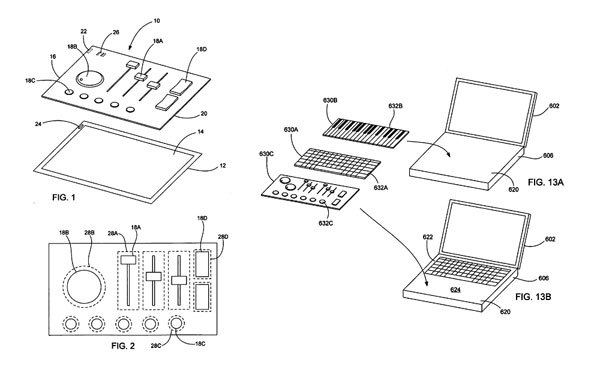
According to a patent filing that Appleinsider dug up, Apple is working on (or at least aiming to patent) a multi-purpose touch-sensitive input solution. While patent filings may be deceiving, this pretty much looks like a swappable keyboard/touchpad solution. You could place a QWERTY keyboard on top of it, a piano keyboard, a trackpad, or just about any similar input device that can take advantage of a touch-sensitive surface behind it.

Apple has filed a lot of exciting or crazy hardware patents that went nowhere. There were detachable, wireless screens. Mice with iPod-like scrolling devices. Tablet computers. And really, when was the last time any Mac shipped with a revolutionary ingenious hardware element comparable to such a multi-purpose input device?

Perhaps this has more to do with a handheld device than with a Mac? If and when the touchscreen iPod becomes real, it could allow for an input area large enough to contain a QWERTY keypad, either virtual (i.e. displayed on the screen), or as a strap-on like in this patent filing. And if the iPod gets a QWERTY, it may take on a completely new life with vastly expanded capabilities. Its software is quite advanced even today, and just imagine what could happen to the platform if its greatest limitation, its lack of input options, could be overcome...

Read More...